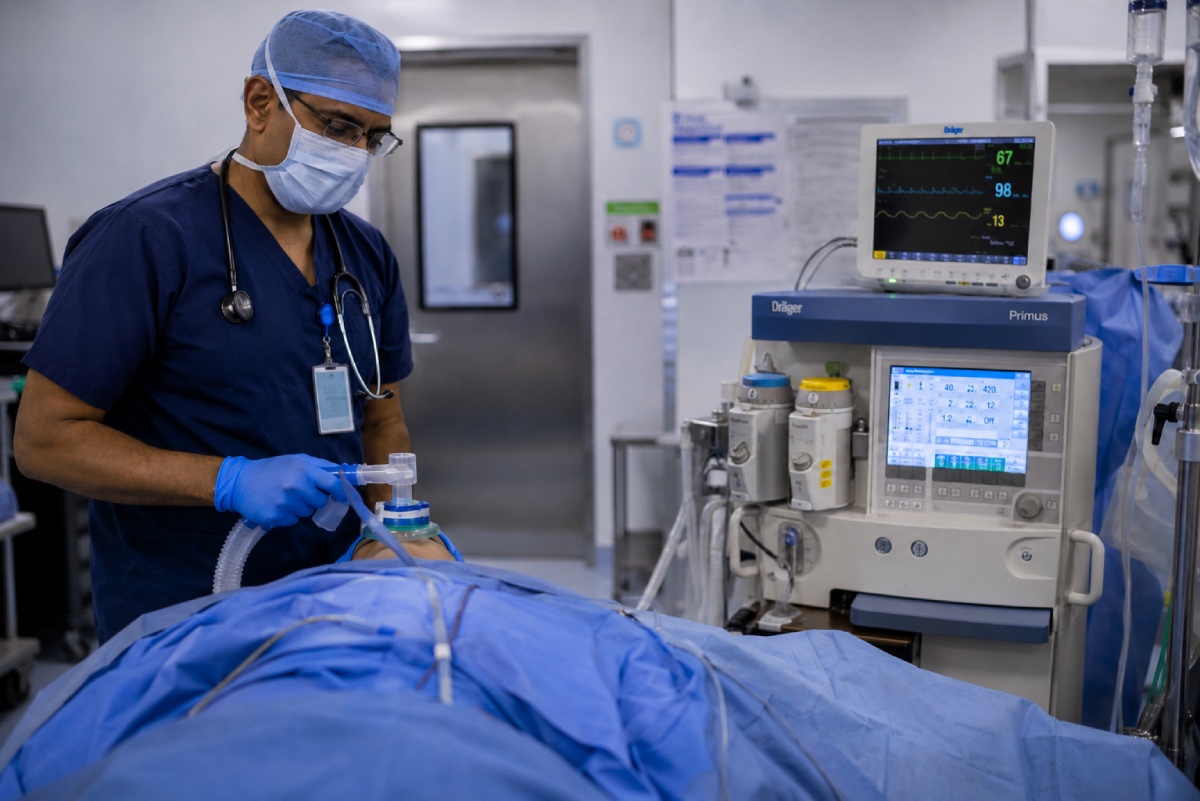
Sevoflurane is widely used because its low blood–gas solubility permits relatively rapid uptake, titration, and emergence compared with older volatile anaesthetics. Yet its predictable pharmacokinetics at the population level should not obscure the clinical reality that individual patients can demonstrate substantial variability in their sensitivity to sevoflurane.
The minimum alveolar concentration (MAC) remains the standard population measure of volatile anaesthetic potency. For sevoflurane, MAC in middle-aged adults is commonly cited near 2%, but this value is not universal. Age is one of the most reproducible determinants of sevoflurane requirement. Early research allowed researchers to develop age-related MAC charts that highlight the progressive decrease in required concentration with age, making the same end-tidal sevoflurane concentration pharmacologically deeper in an elderly patient than in a young adult or child.¹ This is clinically important because under-adjustment may increase the risk of hypotension or delayed emergence in older adults, whereas over-reliance on adult MAC values may underdose younger patients.
Sevoflurane’s low blood–gas partition coefficient supports rapid equilibration, which drives its reliability and clinical utility. Behne et al. found that sevoflurane uptake and elimination are governed largely by solubility, ventilation, circulation, and tissue distribution, while only a small absorbed fraction is metabolized.² They also noted that available data did not show major pharmacokinetic differences in children, obese patients, or patients with renal insufficiency, although special populations may differ in metabolic by-products such as serum fluoride.² These findings demonstrates that, at the group level, these populations with altered metabolism still respond predictably to sevoflurane.
A study of 30 adults measured each participant’s time to reach several clinical endpoints when receiving the same inhalational induction regimen with 6% sevoflurane.³ Lambert et al. found that with this standardized dosing, the time to loss of consciousness ranged from 45 to 135 seconds, the time to BIS 60 ranged from 75 to 270 seconds, and the time to minimum BIS ranged from 120 to 720 seconds.³ These data demonstrate the individual-level variability in sevoflurane response and sensitivity. Notably, age, weight, body mass index, baseline heart rate and end-tidal sevoflurane at BIS 60 did not reliably predict the time to BIS 60; only the time to loss of response to verbal command was significantly associated with it.³
Psychological and nociceptive factors may also influence anesthetic requirements during maintenance anesthesia. Kil et al. found that preoperative anxiety predicted propofol requirements during induction, while pain sensitivity, measured by a pain sensitivity questionnaire, correlated with MAC-hours of sevoflurane needed to maintain a BIS target of 40–50.⁴ This suggests that maintenance sevoflurane concentration may partly reflect an individual’s nociceptive processing rather than hypnotic need alone. The finding is especially relevant because anesthetic depth is a composite of hypnosis, analgesia, autonomic responsiveness, and immobility, each of which may vary.
These studies illustrate some of the factors that drive individual variability in sevoflurane sensitivity. Age-adjusted MAC provides an essential starting point, but it is not a substitute for individualized titration. End-tidal concentration, BIS trends, haemodynamic responses, surgical stimulation, opioid co-administration, and patient-specific traits should be interpreted together.
References
- Nickalls, R. W. D. & Mapleson, W. W. Age-related iso-MAC charts for isoflurane, sevoflurane and desflurane in man. Br. J. Anaesth. 91, 170–174 (2003). https://doi.org/10.1093/bja/aeg132
- Behne, M., Wilke, H.-J. & Harder, S. Clinical pharmacokinetics of sevoflurane. Clin. Pharmacokinet. 36, 13–26 (1999). https://doi.org/10.2165/00003088-199936010-00002
- Lambert, P., Junke, E., Fuchs-Buder, T., Meistelman, C. & Longrois, D. Inter-patient variability upon induction with sevoflurane estimated by the time to reach predefined end-points of depth of anaesthesia. Eur. J. Anaesthesiol. 23, 311–318 (2006). https://doi.org/10.1017/S0265021506000123
- Kil, H. K. et al. Preoperative anxiety and pain sensitivity are independent predictors of propofol and sevoflurane requirements in general anaesthesia. Br. J. Anaesth. 108, 119–125 (2012). https://doi.org/10.1093/bja/aer305