Disclaimer: This article is intended solely for informational and educational purposes only. It does not constitute medical advice.
Propofol is a short-acting intravenous anesthetic widely used for induction, maintenance of general anesthesia, and procedural sedation. Its rapid onset and relatively prompt recovery are attributable to extensive tissue distribution and efficient metabolic clearance. However, the relationship between its clinical duration of action and complete elimination from the body is complex. Understanding the metabolism and elimination of propofol from the body is essential for appropriate dosing, particularly during prolonged infusions and total intravenous anesthesia (TIVA) [1,2].
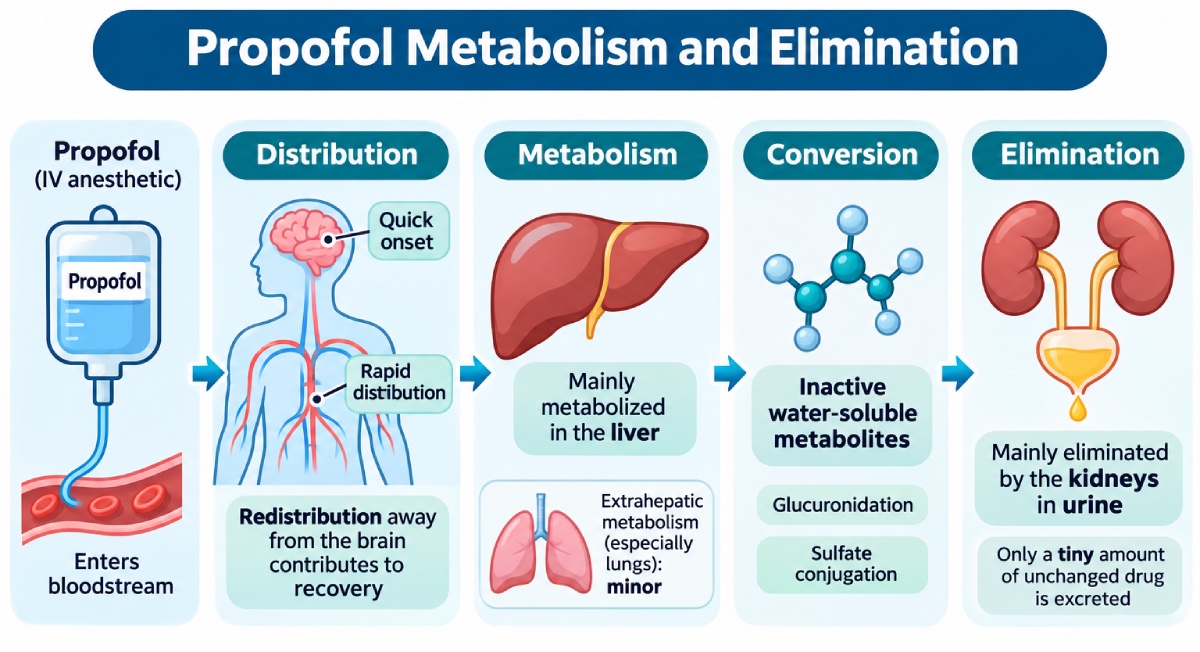
Distribution plays a major role in determining the duration of propofol’s effects. Following intravenous administration, propofol rapidly enters highly perfused tissues, including the brain, before redistributing into muscle and adipose tissue. Its high lipid solubility produces extensive tissue distribution, with an initial distribution half-life of approximately 2–4 minutes. Consequently, recovery following a single bolus primarily reflects redistribution away from the central nervous system rather than complete drug elimination [1,2].
The liver is the principal pathway of propofol metabolism. Approximately 70% undergoes direct glucuronidation by uridine diphosphate-glucuronosyltransferase 1A9 (UGT1A9), producing propofol glucuronide. About 29% undergoes oxidative metabolism, primarily through cytochrome P450 enzymes CYP2B6 and CYP2C9, producing hydroxylated metabolites that subsequently undergo conjugation. Oda et al. demonstrated that CYP2B6 was the predominant enzyme responsible for propofol oxidation in human liver microsomes. CYP2B6 inhibition reduced propofol metabolism substantially, while recombinant CYP2B6 exhibited greater metabolic activity than other tested isoforms [3,4].
Elimination occurs predominantly through renal excretion of metabolites rather than unchanged propofol. Approximately 1% of the administered dose is excreted unchanged in urine, while most undergoes metabolism before renal clearance. Although hepatic metabolism predominates, extrahepatic pathways, including renal glucuronidation, may also contribute. Propofol has a high hepatic extraction ratio, making systemic clearance particularly dependent on hepatic blood flow [3–5].
Elimination half-life must be distinguished from clinical recovery time. Morgan et al. examined seven patients receiving propofol infusions lasting up to nine hours and reported terminal elimination half-lives ranging from 13.1 to 44.7 hours. Systemic clearance ranged from 1.02 to 1.63 L/min, while the apparent volume of distribution was exceptionally large. Despite prolonged terminal elimination, blood concentrations initially declined rapidly after infusion cessation. These findings reflect multicompartment pharmacokinetics, in which redistribution governs early concentration changes while gradual release from peripheral tissues determines the prolonged terminal phase [2].
Individual variability influences propofol metabolism and clearance. Loryan et al. identified substantially greater concentrations of propofol glucuronide and hydroxylated conjugates in women than men, suggesting sex-related differences in metabolic activity. However, common CYP2B6 and UGT1A9 polymorphisms were not significantly associated with metabolism in their pilot study [5]. More recently, Gerstman et al. reviewed 16 studies involving 1,779 patients and identified selected UGT1A9 variants potentially associated with reduced clearance, lower dose requirements, and delayed emergence. Evidence supporting clinically significant effects of CYP2B6 and CYP2C9 polymorphisms remained limited [4].
These pharmacokinetic characteristics have important implications for continuous propofol administration. Prolonged infusions permit progressive accumulation in peripheral compartments, potentially delaying recovery. Target-controlled infusion systems incorporate multicompartment models and patient characteristics to estimate plasma and effect-site concentrations, although substantial interindividual variability persists [2,4].
Propofol has a rapid clinical recovery that results primarily from redistribution, while its terminal elimination half-life is relatively longer. Understanding its metabolic pathways, extensive tissue distribution, and individual pharmacokinetic variability supports safer dosing and more predictable recovery during anesthesia.
References
- Langley MS, Heel RC. Propofol: a review of its pharmacodynamic and pharmacokinetic properties and use as an intravenous anaesthetic. Drugs. 1988;35(4):334–372. doi:10.2165/00003495-198835040-00002.
- Morgan DJ, Campbell GA, Crankshaw DP. Pharmacokinetics of propofol when given by intravenous infusion. Br J Clin Pharmacol. 1990;30(1):144–148. doi:10.1111/j.1365-2125.1990.tb03755.x.
- Oda Y, Hamaoka N, Hiroi T, et al. Involvement of human liver cytochrome P4502B6 in the metabolism of propofol. Br J Clin Pharmacol. 2001;51(3):281–285. doi:10.1046/j.1365-2125.2001.00344.x.
- Gerstman MD, Zhang RK, Ho KM, et al. Impact of genetic variations on the pharmacokinetics, dose requirements, and clinical effects of propofol: a systematic review. Br J Anaesth. 2025;135(3):594–607. doi:10.1016/j.bja.2025.05.036.
- Loryan I, Lindqvist M, Johansson I, et al. Influence of sex on propofol metabolism, a pilot study: implications for propofol anesthesia. Eur J Clin Pharmacol. 2012;68(4):397–406. doi:10.1007/s00228-011-1132-2.